Urban Tree Management supports discerning clients who understand that thriving trees and landscapes enhance our lives.
Expert Analysis for Safer, Healthier Trees
Professional tree diagnostics identify risks early and give stakeholders the necessary tools to determine a plan of action, based on detailed recommendations from an arborist. This plan will include a tree inventory, risk assessments and mitigation strategies, code compliance recommendations, and other personalized reporting to address your property’s needs. At Urban Tree Management, our consulting arborists provide advanced tree diagnostics to property owners and managers in the mid-Peninsula region of the Bay Area.
Why Professional Tree Diagnostics Matter
A consulting arborist licensed by the International Society of Arboriculture (ISA) provides important insights for property owners and managers. The following are reasons why we recommend prioritizing tree diagnostics provided by an ISA-certified consulting arborist:
- Structural safety: Risk assessments identify potential hazards, decay, and structural weaknesses.
- Liability reduction: With official documentation like arborist reports and risk assessments, you will reduce liability associated with tree damage.
- Early detection of decline: Avoid costly tree removals and protect your property by proactively caring for your trees.
- Urban forestry management: Municipalities rely on arborists to develop large-scale plans and tree inventories of street trees, creating standards and best practices for local tree care and maintenance.
- Regulatory compliance: Arborists critically develop reports that ensure compliance with local regulations, either for new development projects or for removals.
- Construction and development planning: Many local governments require arborist involvement to ensure tree protection as part of construction projects.
Comprehensive Tree Inventory Services
We provide complete tree inventory services ideal for property managers, public agencies, and any property owners who manage a large number of trees at once. Tree inventories allow for strategic resource planning, all managed in one convenient database.
What a Tree Inventory Includes
A tree inventory is a comprehensive database of all trees on your property, including details like species, diameter, condition, location, and required maintenance.
Field Data Collection & Tree Tagging
Our team gathers field data about each individual tree on your property and applies a tagging system to differentiate species, condition, and other important characteristics. We double-check for accuracy to ensure proper categorization.
GIS Mapping & Spatial Analysis
GIS mapping allows our team to create interactive maps and databases containing your trees and deliver updates in real time. These reports can then be shared with relevant teams and stakeholders within your organization.
Health, Condition, and Risk Ratings
An inventory will include a condition rating based on the visible state of your tree, as well as a risk assessment. This simplifies resource management, as the tree inventory makes it possible to easily view and prioritize health conditions, structural concerns, and maintenance recommendations.
Long-Term Management Planning
Our team maintains your inventory long term, with ongoing reports and updates in the event of changes to your tree assets. Communications include actionable insights, ideal for HOAs, municipalities, college campuses, and more.
Tree Risk Assessment & TRAQ-Certified Evaluations
During a tree risk assessment, a TRAQ-certified arborist will evaluate trees across your property for structural weaknesses, signs of decay, root damage, and other warning signs.
TRAQ-certified arborists must attend a course and pass exams focused on tree risk assessment and management. This credential, offered by the ISA, indicates an arborist who is able to provide recommendations for risk at scale, improving safety and reducing liability.
When Risk Assessments Are Needed
We recommend annual tree risk assessments, but they may also be recommended after a major storm or any soil disturbances in the vicinity. In the Bay Area, earthquakes may also trigger the need for a tree risk assessment.
Visual, Basic, and Advanced Assessment Methods
An arborist visually inspects the site, soil conditions, and tree appearance before shifting to more advanced structural evaluations.
Structural and Environmental Risk Factors
The assessment also includes a review of structural factors, including potential root decay, cracks, or weakness in the trunk or branches. These may be caused by pests, diseases, or improper pruning. Environmental risks are also an important part of the evaluation, as indicators like wind stress, erosion, and irrigation may impact the arborist’s proposed plan.
Documentation, Reporting, and Mitigation Plans
We assign a risk rating according to ISA standardized criteria, then build a mitigation plan with pruning, maintenance, and removal recommendations. Regular reports with condition updates and actionable insights make managing risk and liability simple.
Decay Detection & Internal Tree Analysis
Decay often hides within a tree for an extended period of time before it becomes visible. Decay detection is an important part of a risk assessment practice, as it diagnoses decay and rot that may eventually turn a tree into a danger to your property.
Non-Invasive Diagnostic Tools
Non-invasive diagnostics are possible via sonic tomography. This methodology employs sound waves to create an image of the tree’s interior, which helps us identify signs of decay, cavities, or other internal weaknesses without compromising the exterior of your tree.
Resistograph testing is another diagnostic technology. It involves drilling an imperceptible hole into the tree with a needle to measure density, which will help identify the depth and extent of decay.
Identifying Hidden Weakness or Decomposition
Hidden weaknesses are common. Defects like cavities and decay may not be visible to the naked eye, so it is critical to rely on a TRAQ-certified arborist for a thorough inspection of the condition of all parts of your trees.
Root Collar, Trunk, and Limb Integrity Testing
Integrity testing employs unique evaluation methods for each critical structural component of a tree. The root collar is where the roots meet the trunk; signs of structural failure may include root rot, circling roots, missing roots on one side of the tree, or exposed roots. The internal stability of the trunk and the connections between the trunk and the branches will also be inspected.
When Decay Warrants Intervention or Removal
Decay may require intervention if a tree has a thinning canopy, fungal growth, or signs of storm damage. Intervention does not automatically equate to removal and could include pruning, bracing, or ongoing maintenance.
Certified Arborist Reports
An arborist report is often required before a new development or construction project can begin. Compiled by an ISA and TRAQ-certified arborist, these reports highlight tree structure, condition, and ongoing maintenance and management.
Development & Construction Reporting
An arborist report may be required ahead of development or construction to protect existing trees on the property and outline the potential impact of the project. An arborist report aligns local codes with the interest of the development project stakeholders, while balancing environmental concerns.
Tree Protection Plans
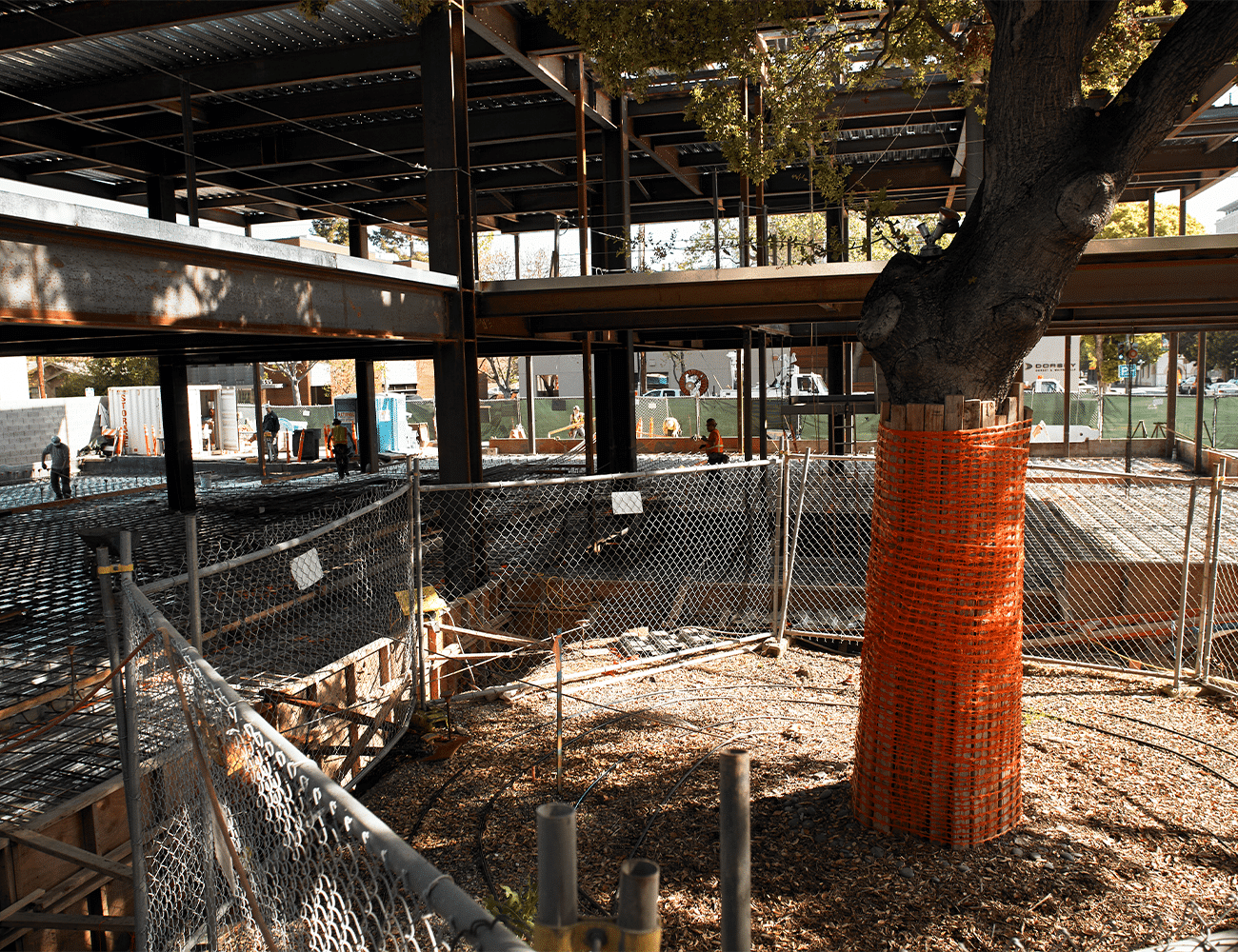
Construction projects can cause unwanted damage to trees on a property if no protection plan is in place. This may include the identification of Tree Protection Zones (i.e. areas where trees and the surrounding soil will be cordoned off), the implementation of trunk guards, or clearly marking trees that should remain to avoid accidental removals.
Permit-Required Removal or Pruning Reports
Local governments and HOAs often require an arborist report to permit a tree removal or large-scale pruning project. An arborist report justifies the removal or pruning recommendation with detailed information about the tree’s condition and health.
Insurance & Legal Documentation
If tree-related property damage does occur, an arborist report provides documentation useful for insurance claims or legal disputes.
Municipal or HOA Compliance Requirements
Many municipalities, public agencies, and HOAs in the Mid-Peninsula require arborist reports to ensure proper compliance with local codes and regulations.
Tree Permitting & Code Compliance Services
Before a development or construction project begins, the proper permits must be obtained. At Urban Tree Management, our arborists are highly familiar with local codes and regulations in the Bay Area, which makes this part of the process seamless.
Local Municipal Tree Ordinances
Local ordinances may include the preservation of certain species of tree, requirements for newly planted trees, conditions for removal, and more. We will assess the property and identify any triggers for permits, as well as any potential concerns related to the project before it begins.
Construction Impact Assessments
A construction impact assessment evaluates the potential effect on the environment and the trees on the property. This results in a fleshed out plan for tree protection that can be submitted as part of the permitting process.
Protected or Heritage Tree Requirements
Protected or heritage trees may have specific requirements, depending on the municipality. For example, Palo Alto has a publicly available list of heritage trees, which all have unique properties and characteristics. Removing protected or heritage trees often requires approval on a case-by-case basis, and it will likely be necessary to prove that the tree must be removed for safety reasons.
Coordination With City Planners and Inspectors
We will coordinate with city officials on your behalf by submitting and handling permits, providing ongoing compliance communications, and staying up-to-date with new regulations.
Municipal, HOA, and Commercial Consulting Services
We assist local governments, HOAs, and commercial property managers with ongoing consulting and support services.
Urban Forestry Management Plans
An urban forestry management plan is an official recommendation with actionable maintenance plans for street trees in a city or other municipal area. These plans take into account local conditions, common species of trees in the area, and a full inventory of trees with actively updated conditions and reporting.
Large-Scale Tree Inventories
Property managers for commercial or college campuses with thousands of trees will benefit from a comprehensive inventory and database for tree management.
Hazard Mitigation Programs
Hazard mitigation programs include a plan for potentially dangerous or unstable parts of trees in high-traffic areas. An arborist creates a strategy for problems like hanging branches, leaning trunks, or visible decay.
Budget Forecasting & Capital Planning
A tree inventory built at a large scale makes it possible to budget for the coming year, based on current tree condition, providing a baseline that can be used to prioritize problem areas.
Policy, Standards, and Best Practices Guidance
For a commercial property, HOA, or municipality, a best practices guide keeps maintenance and policy guidelines easily accessible. This sets the standard for tree care and planting across the property involved.
Diagnostic Tools & Technology Used
Sonic Tomography & Resistograph Testing
Sonic tomography and resistograph testing both detect hidden decay within a tree. Sonic tomography is completely non-invasive and employs sound waves to create a color-coded image of the tree’s interior. Resistograph testing measures density – a microdrill bores a tiny hole deep into the tree and detects the resistance levels, identifying weak spots.
Root Zone & Soil Analysis
The root zone is the soil area surrounding a tree’s roots. An arborist will check root zone depth and visible qualities of the soil, but samples can also be sent for analysis, determining both physical and chemical properties, like pH, salinity, and nutrient availability.
Drone-Based Canopy Inspection
Drone inspections allow tree care professionals to view the canopy of a tree from above, without putting any climbers at risk. This technology identifies any trees with thinning canopies or other issues only properly visible from above.
GIS & Data Management Platforms
GIS mapping and databases hold tree inventories with every detail needed to develop a full picture of all tree assets on a property. GIS mapping even enables the creation of interactive maps based on the recorded location of a tree.
How Diagnostics Support Long-Term Tree Health
Our advanced tree diagnostics in the Bay Area streamline communication and decision-making about tree care, prioritizing safety and cost savings, as well as aesthetics.
Informed Decision Making
With a complete picture of the condition of all trees on your property, you can make decisions based on both budget and need.
Safety & Liability Reduction
With a tree inventory and risk assessment, it becomes easy to reduce the chance of property damage due to a fallen limb, tree diseases or pests, or other tree-related hazards.
Improved Planning for Development Projects
When an arborist is involved in new construction or development projects, tree assessments and planning are built into the design of the property. With this forward-thinking approach, future risks caused by problems like trees planted too close to a new building will be avoided.
Cost Savings Through Proactive Care
With regular maintenance, the trees on your property will thrive, limiting the need for emergency intervention, removals, and costly property damage repairs. Ultimately, you may save money by getting ahead of tree-related damage with regular care from an arborist.
Request an Advanced Tree Diagnostics Consultation
Contact the team at Urban Tree Management to request an advanced tree diagnostics consultation with a consulting arborist. We provide our services in the Mid-Peninsula region of the South Bay, commonly including communities like Palo Alto, Woodside, and more.
What Happens Next
- Consultation & Scope Definition: We begin our initial consultation and determine which diagnostic services best match your needs.
- On-Site Assessment: Our team will visit your property and, under the direction of a consulting arborist, catalog and assess your trees.
- Data Analysis & Reporting: Once all field data is collected, we create a tree inventory, analyze the current condition of trees on your property, and develop reports for easy access to tree health status.
Recommendations & Mitigation Planning: Next, we create a plan for trees on your property, which may include pruning, disease or pest treatment, removals, fertilization, and more.